
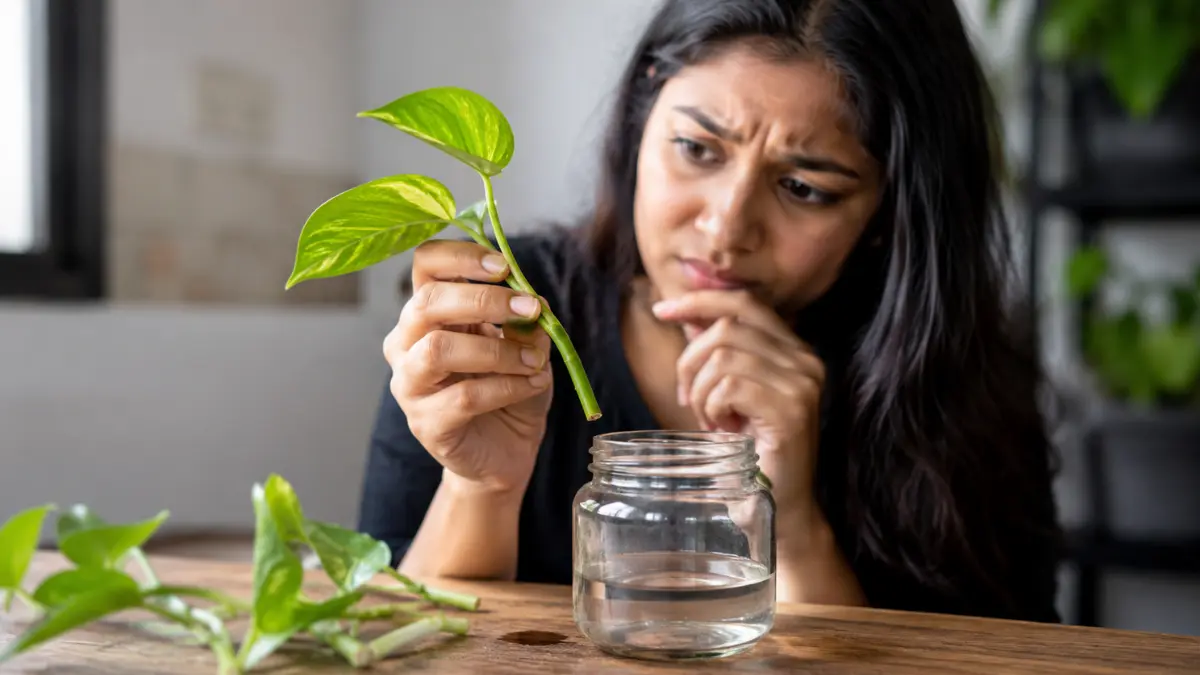
A money plant cutting may fail to grow roots when it has no viable node, the node stays above the waterline, the stem is damaged or the cutting receives unsuitable light and temperature conditions.
A healthy cutting does not need fertiliser, sugar or homemade rooting mixtures. It needs a firm stem, at least one submerged node, clean water, bright indirect light and stable warmth.
Do not discard the cutting only because roots have not appeared within a few days. First check its age, node position, stem condition and growing environment.
How Long Does a Money Plant Cutting Take to Grow Roots?
A healthy money plant cutting may show its first root within one to three weeks. Some cuttings need about four weeks when temperatures are cooler, light levels are lower, or the stem came from an older part of the vine.
A cutting that has remained in water for less than two weeks may simply need more time. Avoid removing it repeatedly or changing its position every day.
Inspect the setup more carefully when the cutting has remained unchanged for two to four weeks. Check whether the node is submerged, the stem remains healthy, and the container receives bright indirect light.
A cutting that shows no root activity after four weeks may still recover, but it requires a closer inspection of the node and stem.
Continue waiting when:
- The stem remains firm
- The node has a normal colour
- The leaves remain mostly green
- The water smells fresh
- No soft or black tissue appears
- Small pale bumps are forming near the node
Tiny white or cream bumps near the node often appear before a visible root extends. Do not scrape or press these bumps.
Check Whether the Cutting Has a Node
A money plant cutting must contain at least one healthy node. The node is the slightly raised joint where a leaf, aerial root or new shoot connects to the main vine.
New roots usually emerge from or near this point. A leaf and its stalk without a stem node may remain green temporarily but it will not develop into a complete new vine.
Inspect the section below the leaf. A healthy cutting should have:
- At least one visible node
- Firm stem tissue around the node
- A short section of stem below it
- One or two healthy leaves
- No black, hollow, or crushed tissue
The node may look like a ring, small bump, thickened joint or brown aerial-root point. It does not need to have a visible root before entering the water.
When the cutting has no node, leaving it in water for longer will not solve the problem. Take a new cutting from a healthy vine and cut slightly below a complete node.
Older, hardened stem sections may root more slowly than healthy young vine sections. Choose a firm green section when several options are available.
Keep the Node Underwater and the Leaves Above Water
A healthy cutting may still fail to root when the node remains above the waterline. Submerging only the bare cut end is often not enough.
Position the cutting so at least one node stays underwater. Keep the leaves and most of the upper stem above the surface.
Correct the placement when:
- Only the bottom tip touches the water
- The node sits above the surface
- Evaporation repeatedly exposes the node
- A leaf remains underwater
- Too much of the stem is submerged
Check the water level regularly because evaporation can expose the node even when the container still appears partly full.
Do not submerge the leaves. Leaves that remain underwater may soften, decay, and contaminate the container before roots form.
Remove a lower leaf only when it would otherwise sit below the waterline. Keep at least one healthy leaf whenever possible because the cutting still needs foliage while developing roots.
Check Whether the Cutting Is Still Healthy
A cutting cannot root properly when the only node has started to decay. Remove the cutting briefly and inspect the submerged section under good light.
Healthy stem tissue should feel firm. It should not collapse, release liquid, or smell unpleasant.
Warning signs include:
- A soft or slippery node
- Black tissue spreading along the stem
- A hollow lower section
- A sour or rotten smell
- A stem that collapses under light pressure
When only the lower end is damaged but a firm healthy node remains above it, trim back to healthy tissue with clean, sharp scissors.
When decay has entered the only available node, the cutting may need a higher healthy node or a completely new vine section.
Do not turn this article into a full rot-treatment process. Follow the separate guide on money plant root rot in water when the stem is soft, black, slimy or foul-smelling.
Correct the Water, Light and Temperature
After confirming that the cutting has a healthy node, correct the surrounding conditions.
Refresh the Water
Use clean water at room temperature. Refresh it approximately once a week, or sooner when it becomes cloudy, slimy, discoloured, or unpleasant-smelling.
Wash the container before refilling it when algae, residue, or decomposing plant material appears inside.
Do not change the water several times a day. Repeated handling can disturb early root development.
Maintain enough water to keep the node submerged. Refill the container when evaporation lowers the waterline.
Use a Suitable Container
Choose a clean container that supports the cutting without forcing the leaves underwater.
A clear jar makes the node and early root growth easier to inspect. Keep it away from harsh direct sunlight because clear glass may heat quickly and encourage algae.
Avoid a bottle with an extremely narrow opening. New roots may become trapped and break when the cutting is removed later.
Provide Bright Indirect Light
Place the cutting in bright, indirect light. Weak light can slow root development, while strong direct sunlight can heat the water and stress the leaves.
Suitable locations include:
- Near an east-facing window
- Behind a thin curtain
- A short distance from a bright window
- A well-lit room without harsh afternoon sun
Do not place the cutting in a dark corner simply because an established money plant can tolerate low light. A fresh cutting benefits from better light while forming its first roots.
Move the container away from direct sun when the glass becomes warm or the leaves develop pale, dry patches.
Maintain Stable Warmth
Money plant cuttings root more slowly in cold conditions.
Keep the container away from:
- Air-conditioner outlets
- Cold window glass
- Strong fan airflow
- Room heaters
- Very hot windowsills
- Locations with sharp temperature changes
Do not use hot water or attempt to heat the container artificially. Stable room conditions are safer.
Do Not Add Fertiliser Before Roots Develop
A fresh money plant cutting does not need fertiliser before it forms a functioning root system.
Fertiliser cannot create a missing node or repair a damaged stem. A strong concentration may harm the submerged tissue or burn newly forming roots.
Do not add sugar, milk, tea, rice water, banana water, or unmeasured homemade mixtures. These materials can contaminate the water and encourage decay.
Plain clean water is enough during the early rooting stage.
How to Fix a Money Plant Cutting That Is Not Rooting
Follow this correction process once rather than making new changes every day:
- Remove the cutting and inspect the node.
- Confirm that the cutting contains at least one complete node.
- Check that the node and surrounding stem remain firm.
- Trim only damaged lower tissue when a healthy node remains.
- Remove any leaf that would stay underwater.
- Wash and refill the container with clean room-temperature water.
- Place at least one healthy node below the waterline.
- Keep the leaves above the surface.
- Move the container to bright indirect light.
- Protect it from cold drafts and strong heat.
- Refresh the water approximately once a week.
- Leave the cutting undisturbed while watching for root bumps.
Do not add fertiliser or rooting mixtures after making these corrections.
Signs That Roots Are Starting to Form
The first root may begin as a tiny pale point rather than a long white strand.
Positive signs include:
- Small white or cream bumps near the node
- A thin pale root emerging from the stem
- A slightly swollen but firm node
- Leaves remaining upright
- A new leaf beginning to open
- Clear water without a bad smell
- Gradual root extension over several days
Do not remove the cutting every day to measure the roots. Early roots are delicate and can break easily.
Brown aerial-root bumps may also change after entering the water. Do not scrape them away.
When to Recut or Replace the Cutting
Recut or replace the money plant cutting when the current section cannot produce healthy roots.
A restart is appropriate when:
- The cutting has no node
- The only node is soft or black
- The lower stem continues deteriorating
- The stem has become hollow
- A healthy higher node remains available
- The original cutting came from badly damaged tissue
Cut slightly below a firm healthy node and place the corrected section in clean water.
Discard the cutting when no firm node remains or decay has spread through the entire stem. Keeping a completely decomposed cutting in the container may affect other cuttings.
Why are the leaves turning yellow before roots appear?
A rootless cutting may yellow when it came from weak tissue, receives unsuitable light, or begins developing stem damage. Use the separate guide on money plant leaves turning yellow in water for a focused diagnosis.
