
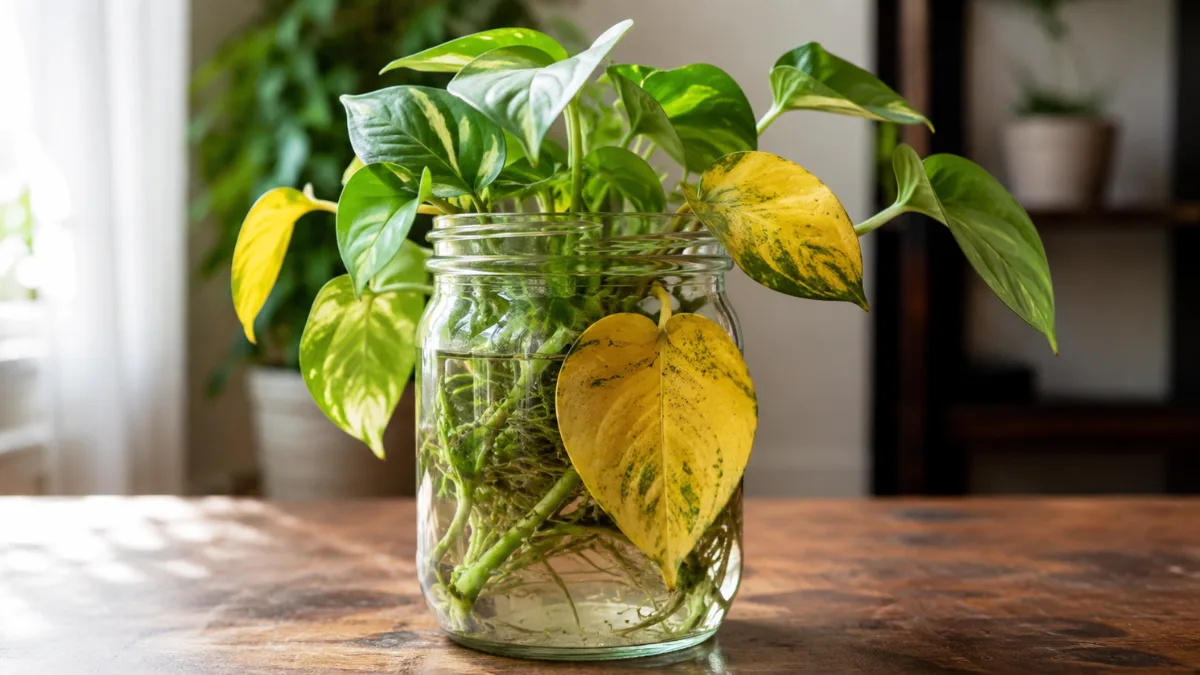
Money plant leaves can turn yellow in water when the water becomes stale, roots begin to decay, light conditions are unsuitable, or a long-established plant lacks nutrients. One older yellow leaf may reflect normal ageing, but several yellow leaves, soft roots, cloudy water, or weak new growth indicate that the growing conditions need attention.
This guide refers to pothos, or Epipremnum aureum, the trailing houseplant commonly called money plant in India. It focuses only on money plants growing in bottles, jars, vases, or other water-filled containers.
Is One Yellow Money Plant Leaf Normal?
One older leaf near the bottom of the vine may naturally turn yellow before falling. Plants sometimes redirect energy away from ageing leaves and toward newer growth.
A single yellow leaf is usually not a serious concern when:
- The remaining leaves are green and firm
- The stem feels healthy
- The roots look firm
- The water is clear
- New growth is still developing
The plant needs closer attention when several leaves turn yellow within a short period or when yellowing appears alongside other symptoms.
Warning signs include:
- Cloudy or foul-smelling water
- Soft, slimy, or collapsing roots
- A black or weak stem near the waterline
- Drooping leaves
- Small or pale new growth
- No new growth for a long period
- Several leaves yellowing at the same time
A yellow leaf normally does not become green again. Recovery appears through healthy roots, stable green foliage, and new growth.
Stale Water Can Stress the Roots
A money plant growing in water depends on the condition of that water. Water that remains unchanged for too long can collect dead root material, dust, algae, and other organic matter.
The water may then become cloudy or develop an unpleasant smell. Root health can decline when the container remains dirty and the water contains little fresh oxygen.
Check the water at least once a week. Replace it when:
- It becomes cloudy
- It smells unpleasant
- A slippery layer develops inside the container
- Dead root pieces collect at the bottom
- Green algae become excessive
- The roots appear coated in slime
During early rooting, changing the water approximately once a week provides a practical routine. A clean container may need less frequent attention once the roots are established and the water remains clear.
Rinse the container with plain water before refilling it. Avoid leaving soap, disinfectant, or cleaning-product residue inside the bottle or jar.
Root Damage Can Cause Several Leaves to Turn Yellow
Yellow leaves often develop when the root system can no longer support the plant properly.
Healthy water-grown money plant roots usually feel firm. They may appear white, cream, light tan, or slightly darker as they mature. Root colour alone does not confirm decay.
Root damage is more likely when the roots are:
- Soft or mushy
- Slimy
- Hollow
- Collapsing when touched
- Producing a bad smell
- Blackening along with the lower stem
Remove the plant carefully and rinse the roots with clean water. Examine both the colour and texture.
Cut away only the root sections that are clearly soft, decomposing, or hollow. Use clean scissors and avoid removing firm roots simply because they appear brown.
Wash the container and return the plant to clean water. Keep the healthy roots submerged, but do not place the leaves below the waterline.
Extensive root decay is a separate problem that requires more detailed treatment. In this article, root condition serves mainly as an important clue behind the yellowing leaves.
Leaves or Too Much Stem May Be Underwater
Money plant leaves should remain above the water surface. Submerged leaves often soften, decay, and contaminate the water.
For a newly rooting cutting, keep at least one node below the waterline so roots can develop. Once roots are established, the active roots should remain covered, while the leaves and most of the stem stay above the water.
Adjust the plant when:
- A leaf is resting in the water
- A long section of stem is submerged
- The lower stem feels soft
- The water becomes dirty around submerged plant tissue
A narrow-necked container can hold the vine upright, but the opening should remain wide enough for the roots to be removed without damage.
Long-Term Growth in Plain Water Can Cause Nutrient Shortage
A fresh cutting can form roots using energy stored in the stem and leaves. This allows the cutting to begin growing in plain water.
However, plain water does not contain every nutrient needed for indefinite growth. A money plant kept permanently in water may eventually show pale leaves, slow growth, or small new leaves.
Nutrient shortage becomes more likely when:
- The roots look firm and healthy
- The water remains clean
- The plant receives suitable light
- Older leaves gradually become pale
- New leaves remain unusually small
- Growth has slowed after several months in plain water
Do not fertilise a fresh cutting before it develops a healthy root system.
For an established plant kept permanently in water, use a nutrient product specifically labelled for hydroponic or water-grown plants. Follow the product instructions for water culture and begin cautiously.
Do not guess the quantity or add concentrated garden fertiliser to a small container. Excess nutrients can damage the roots and make the yellowing worse.
Replace the nutrient solution according to the product guidance instead of repeatedly adding more fertiliser to the same water.
Very Weak Light Can Worsen an Existing Problem
Money plants tolerate lower light better than many indoor plants, but they still need enough light to maintain healthy growth.
Very weak light may not be the only cause of yellow leaves. However, it can slow growth and make a water-grown plant less resilient when the roots or water conditions are already poor.
Light may be contributing when:
- New leaves are small
- Growth has become slow
- The vine looks weak or stretched
- Variegated leaves lose their pattern
- The plant remains far from any window
- Yellowing appears alongside generally weak growth
Place the plant where it receives bright, indirect light.
Suitable locations may include:
- Near an east-facing window
- A short distance from a bright window
- Behind a thin curtain
- In a well-lit room without harsh direct sun
Move the plant gradually. A sudden change from a dark corner to strong sunlight can create additional stress.
Strong Direct Sunlight Can Bleach the Leaves
Harsh sunlight can make money plant leaves look yellow or pale, especially when the plant sits directly beside a hot window.
Clear glass containers can also warm quickly in direct sunlight. Warm water may place additional stress on the roots.
Strong sunlight is more likely to be involved when:
- Yellowing affects the window-facing leaves
- Pale patches appear on exposed areas
- Brown, dry marks develop
- The container becomes hot
- The water feels noticeably warm during the afternoon
Move the plant away from intense afternoon sunlight. Bright, filtered light is safer than several hours of direct exposure.
Do not move the plant into a completely dark location. The goal is to reduce harsh sunlight while preserving adequate indirect light.
Water Quality May Contribute to Yellowing
Money plants often tolerate normal tap water, but water quality varies between locations.
Hard water may leave white mineral deposits on the container or around the roots. Chemically softened water may contain salts that are unsuitable for many houseplants.
Water quality may be contributing when:
- A white crust forms around the container
- Mineral deposits appear on the roots
- Leaf tips become brown as the leaves yellow
- Several water-grown plants show similar symptoms
- The plant improves after receiving a different water source
Try filtered drinking water when tap water leaves heavy residue. Avoid chemically softened water.
Changing the water source alone will not repair decayed roots, so inspect the roots, container, light, and nutrient conditions at the same time.
Temperature Stress Can Affect the Leaves
Money plants prefer stable indoor temperatures. Direct airflow from an air conditioner, cold winter drafts, room heaters, and hot windows can stress the foliage.
Temperature stress may be involved when yellowing begins soon after the plant is moved.
Keep the container away from:
- Direct air-conditioner airflow
- Room heaters
- Hot kitchen appliances
- Very cold windows
- Glass that becomes extremely hot during the day
Stable conditions support recovery better than repeated movement between hot and cold locations.
How to Help a Water-Grown Money Plant Recover
Begin by checking the roots, water, container, and light conditions together.
Remove the plant carefully and rinse the roots with clean water. Cut away only roots that are clearly soft, slimy, hollow, or decomposing.
Wash the container and refill it with clean water. Keep the healthy roots submerged, but leave all leaves above the surface.
Place the plant in bright, indirect light. Avoid direct afternoon sunlight and strong air-conditioner airflow.
Do not add fertiliser immediately when the roots are damaged. Allow the plant to stabilise in clean water first.
If the roots are healthy and the plant has remained in plain water for several months, introduce a properly diluted nutrient product intended for water-grown plants.
Remove leaves that have become completely yellow. Partly green leaves may remain temporarily when the plant has very little healthy foliage.
Do not make several major changes repeatedly. After correcting the obvious problem, give the plant time to respond.
Signs That the Money Plant Is Recovering
Existing yellow leaves are not the best indicator of recovery because they usually remain yellow.
Look for:
- Firm new roots
- Clear water without an unpleasant smell
- No additional yellow leaves
- Stable green colour in unaffected leaves
- A firm stem near the waterline
- A new leaf beginning to open
- New growth developing from a healthy node
Growth may pause temporarily while the plant restores its roots. Healthy new growth is more important than rapid vine length.
If black or soft decay has spread through most of the stem, the affected vine may not recover. Remove decayed tissue from the container so it does not remain beside healthy roots. Saving an undamaged cutting should be handled as a separate propagation topic.

1 thought on “How to Fix Money Plant Leaves Turning Yellow in Water”