
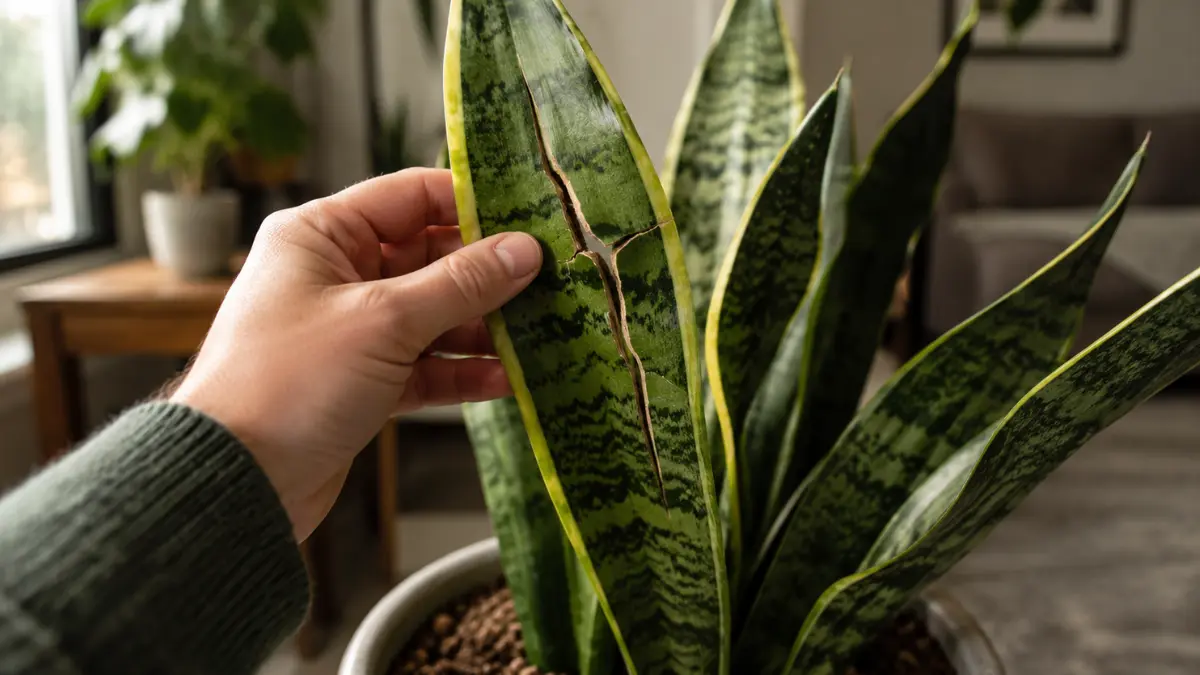
Snake plant leaves usually split after a rigid leaf bends, strikes a hard surface, gets squeezed, or develops weak tissue around a damaged area. A clean crack surrounded by firm green tissue normally indicates physical damage, while a soft, yellow, translucent or mushy break can indicate moisture-related deterioration or rot.
The split itself will not close again. However, a damaged leaf can remain healthy when most of its tissue stays firm and green.
The correct response depends on the texture of the damaged area, the condition of the leaf base, and whether other leaves show similar symptoms.
What Causes a Clean Split in a Snake Plant Leaf?
Physical damage causes most clean cracks in otherwise healthy snake plant leaves.
Snake plant leaves grow upright and hold a large amount of moisture inside thick, rigid tissue. This structure helps the plant tolerate dry conditions, but it also prevents the leaves from bending as freely as thinner houseplant foliage.
A leaf may crease or split after:
- Pressing against a wall or window
- Getting caught in a curtain
- Being struck while the floor is cleaned
- Bending during repotting or relocation
- Being pushed by a pet or child
- Leaning against the edge of a heavy decorative pot
- Getting squeezed between other objects
- Being handled roughly while the leaves are wiped
The damage may not become fully visible immediately. A small crease can gradually open as the leaf continues growing or shifts toward the light.
A physically damaged leaf usually has firm green tissue around the crack. The split may look dry, sharp, or slightly calloused. The plant may continue producing healthy growth, and no unpleasant smell should come from the soil or leaf base.
One damaged leaf normally does not indicate a serious plant-care problem.
Moisture problems do not appear the same in every growing method. A snake plant in wet soil may develop soft roots and collapsing leaves, while a plant kept directly in water can show changes inside the container instead. The guide to why money plant water turns green explains what causes that separate water-quality problem and how to control it.
How Can Physical Damage Be Identified?
A close inspection of the leaf provides the clearest diagnosis.
Physical damage is likely when:
- Only one or two leaves are affected
- The split has clean or dry edges
- The damaged leaf remains firm
- The tissue around the crack remains green
- The leaf base feels solid
- The soil does not remain constantly wet
- Other leaves remain upright and healthy
- New growth appears normal
The position of the split may also provide a clue. Damage near a wall, curtain, furniture edge, or pot rim often shows where pressure occurred.
A bent section may eventually tear because the thick internal tissue cannot return to its original shape. The leaf may remain partly upright or begin leaning from the damaged point.
The plant should be moved only when its current position exposes the leaves to repeated contact. A stable location with enough space around the foliage prevents new injuries more effectively than tying the leaves together.
Tight ties should be avoided. They can press into the leaf surface, restrict natural movement, and create new weak points.
Is It a Clean Split or Soft Tissue Collapse?
Not every broken-looking leaf has suffered ordinary physical damage.
A soft or discoloured break can develop when tissue loses strength because of excessive moisture, root damage, or decay. In this situation, the leaf may fold, tear, or collapse even without a strong physical impact.
The damaged area requires closer attention when it appears:
- Yellow
- Translucent
- Water-soaked
- Brown and soft
- Mushy near the base
- Dark around the split
- Loose at soil level
- Unpleasant-smelling
Several declining leaves also suggest that the problem extends beyond one accidental crack.
A healthy split normally feels firm. A moisture-related collapse feels soft, weak, or unstable.
The leaf base deserves particular attention. A firm base suggests that the remaining tissue may still function normally. A mushy base can indicate that rot has reached the lower leaf, roots, or underground rhizome.
Additional watering should not be used as an immediate response to a weak or collapsing leaf. Wet roots can stop functioning properly even while the potting mix contains plenty of moisture.
When the soil stays wet for many days, the leaf bases soften, or several leaves begin falling sideways, a root inspection becomes necessary.
Can Overwatering Split Snake Plant Leaves?
Overwatering does not normally create a neat crack in firm, healthy tissue. It causes a different type of damage.
Constantly wet soil can deprive roots of healthy growing conditions and allow decay to develop. As roots and rhizomes deteriorate, the leaves may yellow, soften, bend, or collapse.
A weakened leaf may then tear, but the visible break is a result of damaged tissue rather than a normal split caused directly by water pressure.
Signs that point toward excess moisture include:
- Soil that remains wet long after watering
- A pot without drainage holes
- Water collecting inside an outer decorative pot
- Yellow leaves near the base
- Soft or blackened roots
- A sour smell from the pot
- Leaves that pull away easily
- Several leaves collapsing during the same period
The plant should be removed from the pot when the lower tissue feels mushy or the soil smells rotten.
Healthy roots and rhizomes should feel firm. Clearly soft, dark, or slimy sections should be removed with a clean cutting tool. The remaining healthy plant can then be placed in fresh, fast-draining potting mix inside a container with drainage holes.
This level of treatment is unnecessary for a single clean split on a firm green leaf.
Can Dry Soil Cause Snake Plant Leaves to Split?
Dry soil more commonly causes wrinkling, folding, inward curling, and loss of leaf thickness than actual tearing.
A severely dehydrated leaf may become less rigid and easier to damage, but a visible split still normally requires pressure, bending, or impact.
An intact leaf that folds or curls inward has a different primary symptom. The guide to snake plant leaves curling inward explains how to separate dry-soil stress from root damage without confusing it with a true crack or tear.
A split leaf should therefore not be treated automatically as an underwatering problem.
Before watering, the soil condition should be checked. Water is appropriate when the potting mix has dried and the roots remain healthy. Water is not appropriate when the soil is already wet or the leaf base feels soft.
Can Cold Conditions Damage Snake Plant Leaves?
Cold exposure does not normally produce a neat crack in healthy tissue. It can damage and soften exposed areas, making the leaf more likely to bend, tear, or collapse.
Cold-related damage often appears on the side of the plant facing:
- An air-conditioning vent
- A cold window
- An exterior door
- A strong winter draft
- A sudden change between warm and cool locations
The affected tissue may look dark, translucent, soft, or water-soaked rather than cleanly split.
A damaged area will not recover after the tissue has broken down. The plant should be moved to a stable indoor location away from cold glass and direct airflow.
The pot should not sit in wet soil during cool conditions. Low temperatures slow water use, which allows the potting mix to remain damp longer and increases the risk of root damage.
Will a Split Snake Plant Leaf Heal?
A split snake plant leaf will not reconnect.
The edges may dry and form a firm callus, but the crack or scar will remain visible. No product can rebuild the separated tissue.
Glue, tape, wax, wound sealant, and similar materials should not be applied. These treatments do not restore the leaf and may trap moisture against the damaged area.
A firm green leaf can still support the plant through photosynthesis. Removal is not necessary only because the leaf has a visible scar.
The damaged leaf may remain functional for a long time when:
- The base stays firm
- The split remains dry
- No yellowing spreads from the damaged area
- The leaf can support its weight
- No signs of rot develop
A loose support can help a tall leaf that bends at the split. A small stake and soft tie may hold the leaf upright, but the tie should not tighten around the foliage or press directly against the crack.
Should a Split Snake Plant Leaf Be Removed?
A healthy split leaf can remain attached.
Removing every cosmetically damaged leaf reduces the plant’s green surface and does not improve the condition of the remaining leaves.
Removal becomes reasonable when:
- The leaf hangs heavily from the split
- Most of the leaf has turned yellow or brown
- The base feels soft
- Decay continues spreading
- The leaf cannot remain upright
- The damaged tissue smells unpleasant
- The leaf interferes with healthy new growth
A clean, sharp, sterilised blade should be used when removal is necessary.
The entire leaf should be cut close to the soil line rather than shortened repeatedly from the top. A clean base-level cut produces a neater result and prevents a long damaged stump from remaining above the soil.
The cutting tool should be cleaned before and after use, especially when soft or decaying tissue is present.
Several healthy leaves should not be removed simply to make the plant look symmetrical. The condition of future growth matters more than the appearance of one older damaged leaf.
Does a Crowded Pot Cause Leaf Splitting?
Crowding does not usually create clean leaf cracks directly.
Snake plants naturally form dense clumps through underground rhizomes. A slightly tight pot may remain suitable for a healthy plant.
Severe crowding can create other problems. Expanding rhizomes may distort a plastic pot, crack a rigid container, push above the soil, or make the plant difficult to handle without bending its leaves.
Repotting may be necessary when:
- The container has started buckling or cracking
- Thick rhizomes press strongly against the pot
- The root mass has completely filled the container
- The plant becomes unstable
- Water cannot soak evenly through the root ball
- The pot falls over because the plant has become top-heavy
One split leaf does not justify immediate repotting.
When repotting becomes necessary, the new container should be only slightly wider than the existing root mass. A very large pot holds more damp soil around the roots and can increase the risk of overwatering.
The container must have effective drainage holes.
How Can More Snake Plant Leaves Be Protected?
Existing cracks cannot be reversed, so prevention should focus on protecting new and undamaged leaves.
Give the foliage enough space
The plant should not sit in a narrow walkway or beside frequently moved furniture. Curtains, doors, vacuum cleaners, bags, and pets can repeatedly bend rigid leaves.
A small amount of open space around the plant prevents many accidental tears.
Move the pot carefully
The pot should be lifted from its base rather than pulled by the leaves.
During relocation, the foliage should remain free from door frames, walls, and furniture edges. Tall leaves can be supported loosely by hand without squeezing them together.
Avoid unnecessary handling
Frequent wiping, turning, tying, and rearranging can crease otherwise healthy leaves.
Dust can be removed gently with a soft, damp cloth while the leaf receives support from the opposite side.
Water according to soil condition
A fixed weekly watering schedule does not suit every room or season.
The soil should dry before the next watering. Cooler weather, lower light, and larger pots slow the drying process.
Excess water should drain completely, and no water should remain trapped inside a decorative outer container.
Keep the environment stable
The plant should remain away from strong cold drafts and sudden temperature changes.
Bright indirect light supports steady growth, but sudden exposure to intense sunlight can stress leaves that previously grew in low light.
Watch new growth
Old scars will remain. Healthy new leaves provide the best evidence that the problem has been corrected.
New leaves should emerge firm, upright, and free from soft or discoloured areas.
When Does a Split Require a Root Inspection?
A clean split on one firm green leaf normally needs no root inspection.
The roots should be checked when the damage appears with:
- A mushy leaf base
- Persistent wet soil
- Yellowing across several leaves
- Black or translucent tissue
- A rotten smell
- Sudden leaf collapse
- Leaves pulling away from the rhizome
- Repeated damage in new growth
These signs indicate a wider plant-health problem rather than isolated physical injury.
The most useful distinction is simple: firm green tissue usually points to physical damage, while soft, discoloured, or foul-smelling tissue points to deterioration.
A split leaf cannot repair itself, but it does not always need removal. Protecting the remaining foliage, correcting excessive moisture when present, and judging recovery through healthy new growth provide the most effective response.
